Logistics
F10 menu
The game menu is available under F10 > Other > Tycoon.
My Location
This section refers to the site nearest your aircraft.
- Show stock here displays its available staged crates.
- Spawn any staged places any available crate at the site.
- Spawn cargo lets you choose a specific cargo type.
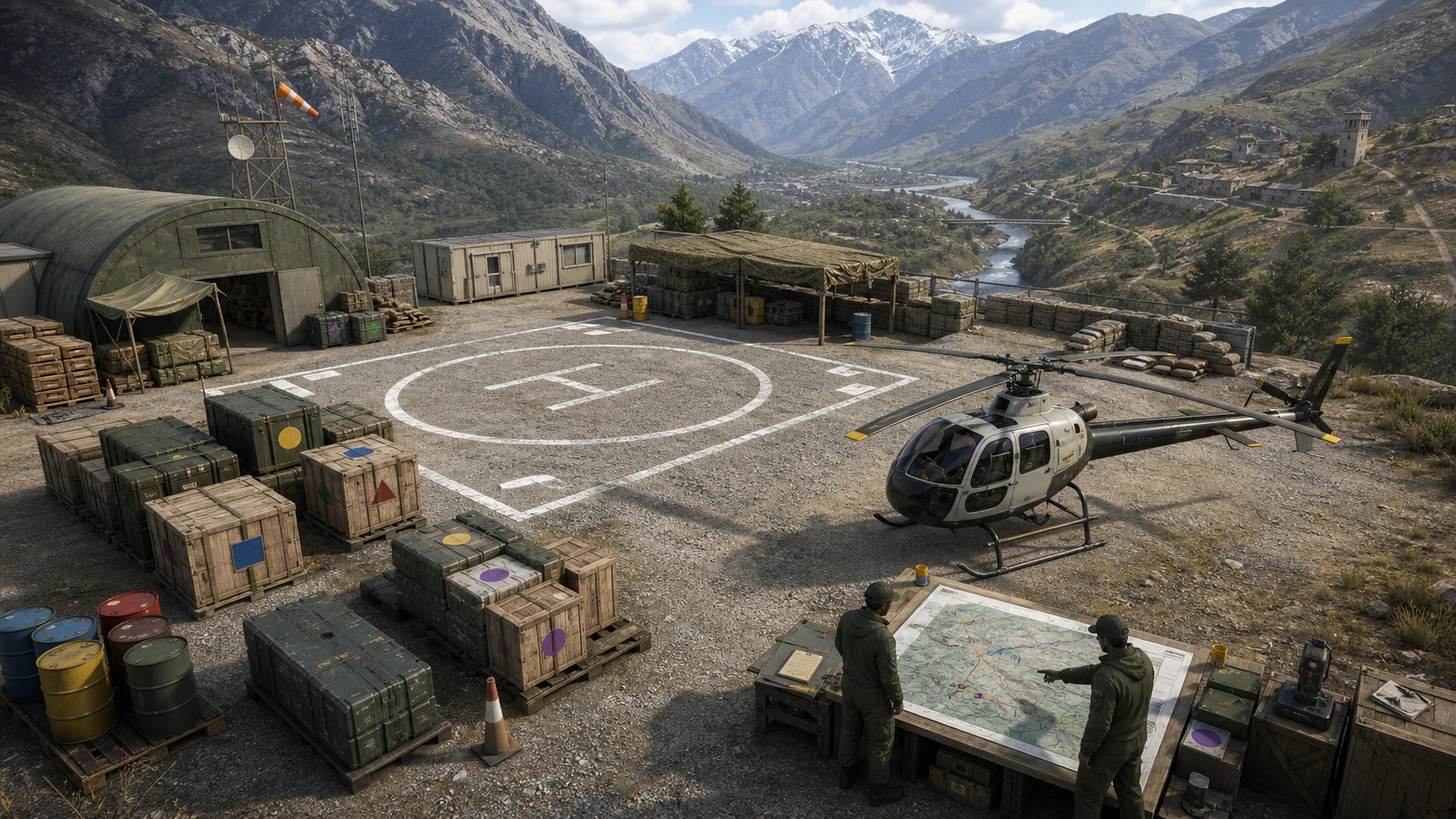
Spawning is not loading. The crate appears at the site and must then be picked up with your aircraft's CTLD cargo commands.
Navigation
- Cargo Sites lists suitable destinations for cargo already aboard your aircraft.
- Nearby Sites lists the nearest factories, sources, hubs, or cities.
- Deploy smoke marks a selected site and reports bearing and distance.
- Refresh nearest sites updates the entries after moving or loading cargo.
Smoke colors:
| Site | Color |
|---|---|
| Source | Green |
| Factory | Blue |
| Hub | Orange |
| City | White |
Smoke is placed about 120 meters to the right of your approach to the site. Another marker becomes available after its cooldown or when you arrive.
FM homing navigation
Tycoon sites also transmit FM homing beacons. Click a site on the Tycoon Map and look for the Radio entry in its description to find the assigned FM frequency.
Tune that frequency in the aircraft's FM homing receiver to navigate toward the site by signal direction. This feature is currently supported only by the UH-1H. Other aircraft should use the map, bearing and distance from the F10 menu, or smoke navigation.
Loading and unloading
- Spawn a crate at the correct site.
- Position your aircraft close enough to the crate.
- Use the CTLD menu to load it.
- Fly to a destination that accepts the cargo.
- Land inside or immediately beside its delivery zone.
- Use the CTLD menu to unload.
Cargo only counts as delivered when dropped inside a matching zone. Outside the zone, it remains a dropped crate in the world.
Practical rules
- Stay within your aircraft's weight and cargo-slot limits.
- When carrying several crates, check whether they share a destination.
- Only spawn cargo you intend to transport.
- If stock is empty, wait, choose another cargo, or visit another source.
- Flying loaded cargo through a low-security region carries a real risk of ambush. See Security & Threats.
Cargo weight and aircraft capacity
Every crate occupies one cargo slot. Loading is allowed only when both conditions are met:
- The aircraft has a free cargo slot.
- The combined weight of all loaded crates remains within its CTLD cargo-weight limit.
This means a helicopter with two slots may still be limited to one heavy crate. Cargo weight is separate from fuel, weapons, and DCS flight-performance limits; leave a sensible margin for takeoff and landing.
Standard crate weights
| Cargo | Weight per crate |
|---|---|
| Wood / Logs | about 125 kg |
| Grain | about 125 kg |
| Food | about 125 kg |
| Lumber | about 125 kg |
| Oil | about 250 kg |
| Steel | about 500 kg |
| Building Materials | about 500 kg |
| Fuel | about 500 kg |
| Industrial Parts | about 1,000 kg |
The exact CTLD definition uses small decimal differences to identify cargo types. Use the weight shown in the live map or cargo menu when it differs from this overview.
Aircraft limits
| Aircraft | Cargo slots | Maximum CTLD cargo weight |
|---|---|---|
| SA342 Gazelle variants | 2 | 510 kg |
| UH-1H | 2 | 1,010 kg |
| Mi-8MT / Mi-8MTV2 | 3 | 3,010 kg |
| Mi-24P / Mi-24V | 2 | 1,010 kg |
| CH-47F | 6 | 6,010 kg |
| UH-60L | 2 | 2,010 kg |
| MH-60R / SH-60B | 2 | 3,500 kg |
| Ka-50 / Ka-50 III | 1 | 130 kg |
| AH-64D | 1 | 130 kg |
| OH-6A / OH-58D | 1 | 130 kg |
| OV-10A Bronco | 1 | 130 kg |
| Mosquito FB Mk VI | 2 | 1,010 kg |
| Hercules mod | 7 | 19,000 kg |
| C-130J-30 | 7 | 21,500 kg |
Examples:
- A UH-1H can carry two 500 kg Steel crates: 2 slots and about 1,000 kg total.
- A Gazelle has two slots, but it cannot carry two 500 kg crates because their combined weight exceeds 510 kg.
- A CH-47F can carry six 1,000 kg Industrial Parts crates, just below its configured limit.
These are Tycoon's configured CTLD limits, not the aircraft manufacturer's published payload figures.